
Colosseum — Concentric, Colonnaded Construction
5th Year Analysis Project (Study Abroad - Rome Italy)
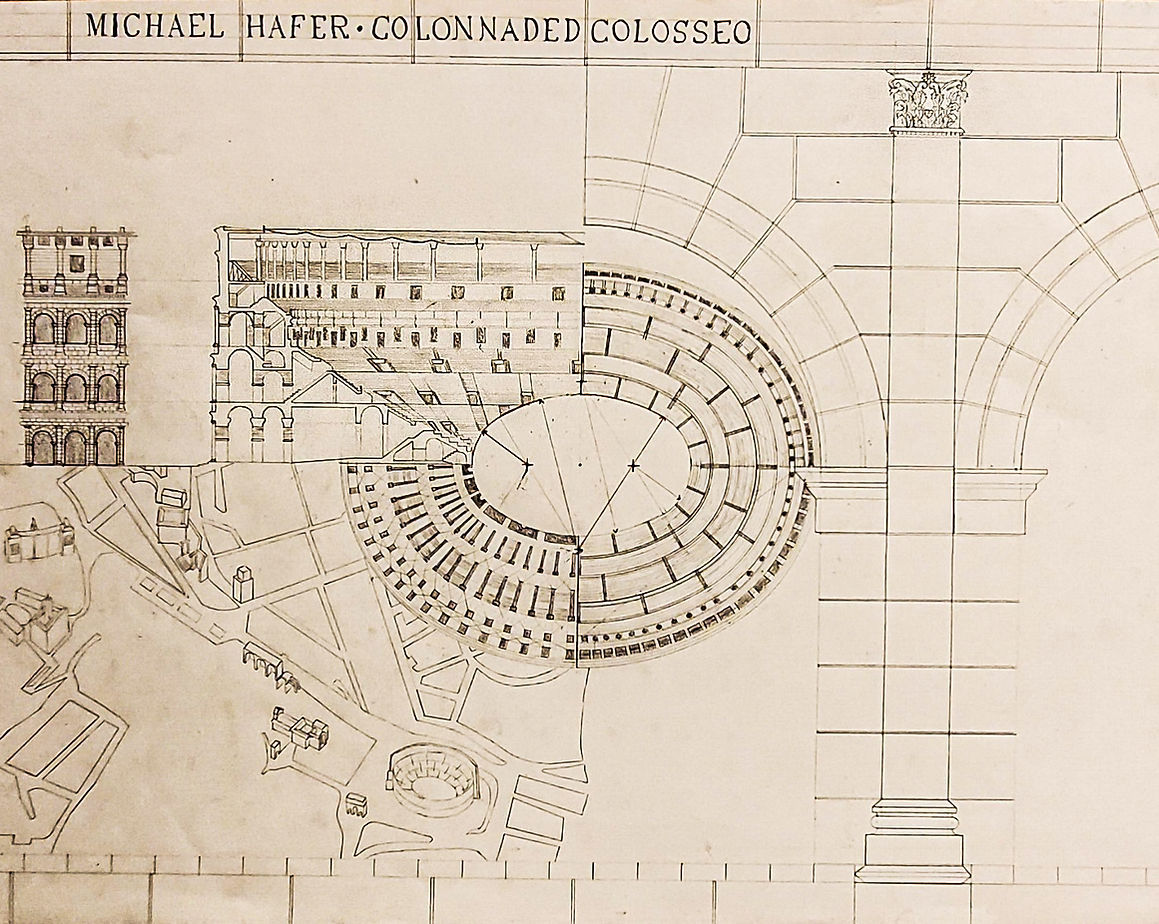
Students were tasked with analyzing a Roman structure (of any era and condition) via hand drawing. The loose requirements were to analyze the structure at 3 scales: at the immensity of the Roman urban scale [1](bottom left), at the composite scale of the building as a whole [2](elevation, plan and section at the top), and at the scale of a single architectural or structural component [3](right). I included the super-imposed plans at arena and roof levels to show the elliptical geometry governing the rest of the design.
[1] The Colosseum was constructed on the ruins of the Domus Arena—the demolished ruins of the despised Emperor Nero's palace—as a political stunt to usurp the memory of Nero. As with the adjacent Roman Forum, the Colosseum (then referred to as the Flavian Amphitheatre) was gifted from the newly-crowned Flavian dynasty to revive the public's faith in the Empire. The Colosseum sits in the heart of Rome and is surrounded by monuments of antiquity and modernity. From right to left; (Temple of Venus, Basilica of Maxentius, Trajan's Market, Michelangelo's Campidoglio, and the Altar of the Fatherland.)
[2] Just like the floor plans, the elevation is dominated by elliptical geometries. A series of three colonnades are stacked on one another and capped with a opaque attic with masts to anchor the awnings. The structural orders sequentially lighten as the building rises. A stout Doric order is at ground level, a strong but elegant Ionic order rests above it, slender and artful Corinthian columns sits above, and finally, an engaged Corinthian pilaster completes the vertical stack.
[3] I singled out a Corinthian column of the exterior colonnade to study. It is engaged with the masonry wall as the grout lines are continuous from the travertine blocks to the column. Arches radiate away from either side of the column. A continuous lintel keys in both the arches and the column. The decorative Corinthian column cap terminates at the lintel and appears to support it. I've titled the project on the lintel with a Roman font.
The elliptical shape of the seating bowl (and supplementary structure below) are controlled by two intersecting arcs. The first is a semi-circular curve at the East and west stands, which connects to a larger arc on the North and south stands. Concentric seating tiers are supported by identically-shaped corridors below. Gangways are staggered so the path of egress for every seat is reasonable.
The plan is divided in a quadrant with the event level plan occupying the bottom left, the upper seating level on the right, and a enlarged section in the top left.
The section illustrates the vertical complexity of the Colosseum as staggered ramps connect the concourses to mid-levels and the seating bowl in various locations. A raised attic space housed the empire's poor attendees and women. The lower bowl is all interconnected. A downward-bowing fabric awning shields the fans from sunlight.
The elevation and section are equally scaled and positioned